KROKE - Tour 2026
„... The idea of the band was from the very beginning a constant search for the new, also within ourselves...“ The musicians admit – „...We want our music to simply be called KROKE MUSIC...“
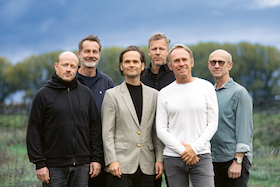
KROKE (Yiddish for Krakow) was founded in 1992 by three friends: Tomasz Kukurba (viola), Jerzy Bawoł (accordion), and Tomasz Lato (double bass). As graduates of the Krakow Music Academy, but also as artists in search, they did not shy away from experimenting with jazz and contemporary music. The band, initially associated with Klezmer music, currently oscillates through various genres. The artists draw inspiration from ethnic music from around the world, but always enrich their works with their own improvisations. In this way, KROKE creates a unique style that transcends borders, forms, and time. KROKE is also one of the first bands to take its music to the public. The musicians could be found on the streets and in the clubs of the Krakow district of Kazimierz, once the Jewish quarter. The musical compositions they played, unknown to some, awakened memories of a long-forgotten world in others. There, one could hear for the first time the songs that appeared on the band's first self-released cassette in 1993.
One day, Kate Capshaw, wife of Steven Spielberg, who was filming "Schindler's List" in Krakow at the time, arrived at the restaurant "Ariel," where the band often performed. One night she took her husband to a concert. The director quickly recognized KROKE's talent and invited the band to Jerusalem to perform at the "Survivors Reunion" ceremony organized for the survivors of Oskar Schindler's list. „...Since that remarkable moment, everything became deeper... That was when the band really started to exist. From those people, some of whom were Klezmorim, we received a kind of musical blessing ...“ – said the musicians. But it was just the beginning of a great adventure. Spielberg sent KROKE's cassette to Peter Gabriel, who invited the band to the UK in 1997 to participate in the WOMAD Festival. The audience responded enthusiastically to both the performance and the band's debut album "Trio." This meeting also led to joint recording sessions at the Real World Studios. Parts of the recordings were later used by Peter Gabriel on the album "Long Walk Home," which was a soundtrack for the film "Rabbit-Proof Fence."
In 1997, the second album – "Eden" – was released. Traditional Klezmer motifs combined with modern musical sensibility gained a new, more intense color this time. Since then, KROKE has increasingly incorporated Sephardic and Arabic patterns, without disconnecting from its traditional Klezmer roots. The result of these explorations was the album "Sounds Of The Vanishing World" – an atmospheric testimony to KROKE's development and the musicians' ability to create their own style. As proof of the band's members' sound decisions, KROKE was awarded the prestigious "Preis der Deutschen Schalplattenkritik" in 2000.
In the summer of 2001, during performances in Cornwall, KROKE first met Nigel Kennedy. The artist immediately expressed his willingness to collaborate, leading to the recording of a joint album – "East Meets East" – in 2003. KROKE was also nominated for the BBC Radio 3 Award in the "World Music" category, and the collaboration with Nigel Kennedy developed into a series of celebrated concerts at European festivals. At this time, another original album was released – "Ten Pieces To Save The World." This melodic and atmospheric album reached second place in the World Music Charts Europe and was the culmination of 10 years of the band.
In 2004, another concert album was released – "Quartet – Live At Home" – recorded at Radio Kraków's 'S-5' recording studio with the involvement of jazz drummer Tomasz Grochot, who performed with the band in the following years.
A year later, the band began collaborating with Edyta Geppert and Krzysztof Herdzin on a new project, culminating in the album "Śpiewam życie." The release was awarded gold and the band simultaneously toured Poland and Germany with the program "KROKE – symfonicznie" together with the Sinfonia Baltica orchestra conducted by Bohdan Jarmołowicz.
In 2006, KROKE's piece "The Secrets of The Life Tree" became the soundtrack for David Lynch's film "Inland Empire," and a year later, for the band's 15th anniversary, KROKE released another studio album – "Seventh Trip" – an energetic journey through oriental music paths.
The following year focused on a series of concerts domestically and abroad, as well as a new project in collaboration with Krzysztof Herdzin, who provided a new approach to Kroke's music with his arrangements. The project premiered during the Polish Cultural Days in Krakow, when the band performed together with Sinfonietta Cracovia under the baton of Robert Kabara, resulting in a unique sound that united classical and modern music. The project was also presented to audiences in Burgos, St. Petersburg, Stockholm, Vasteras, Uppsala, and many other places in and outside Poland, with orchestras like Sinfonietta Västerås, Orquesta Sinfónica de Burgos, AUKSO, NOSPR in Katowice, Elblg Chamber Orchestra, Archetti, or Kalisz Symphonic Orchestra.
2009 was another breakthrough and turning point on KROKE's artistic path. The band increasingly performed as a trio, without drums, making the concerts more intimate, and the music gained long unheard Ashkenazi and Balkan tones. Janusz Makuch, the director of the Jewish Culture Festival in Krakow, called it “a return to the roots,” and the band documented its search with the album "Out of Sight," featuring energetic tracks from the Klezmer tradition alongside compositions from the border of jazz genre and atmospheric vocalizations by Tomasz Kukurba.
In 2010, the band toured together with the Norwegian band Tindra and the Spanish violinist Diego Galaz. Together with Nigel Kennedy, they also performed at the Polish Weekend at the Southbank Centre in London. In January 2011, Maja Sikorowska (vocals) and Sławek Berny (percussion) joined KROKE and recorded twelve Greek songs full of emotions and impressions. The result of this work was the release of an outstanding album – "Avra."
The years 2010 to 2012 were marked by touring collaborations with Mongolian singers Urna Chachar-Tugchi and Krzysztof Herdzin, as well as Anna Maria Jopek, who appeared on an album awarded a gold record titled "Feel the Harmony" with the Sinfonietta Cracovia Orchestra.
In 2014, the album "Ten" was released, which immediately achieved gold record status and was nominated for the Fryderyki Award 2015. The collaboration with Anna Maria Jopek developed. The artists recorded the piece "Psalmia," which was released on the aforementioned album. Together they toured with their project, both in Poland and internationally. A year later, an unusual project developed. "Cabaret of Death" is the result of a collaboration with Polish filmmaker Andrzej Celiński on his work focusing on protagonists of culture and entertainment in Nazi concentration camps. However, it is not a soundtrack album. The group reworked the score into a new arrangement, added new pieces, and recorded the whole again to create a contemplative suite. The year 2016 led to two releases – the reissue of the album "Ten" (supplemented with two new tracks – the Christmas songs "Mizerna Cicha" and "Z narodzenia Pana") and a special Christmas-themed box.
The year 2017 marked a milestone of 25 years of Kroke. The band sealed it with the premiere of their new album – "Traveller." As the musicians said: „... Kroke has been a traveler over the past 25 years, enjoying traveling but also learning from it and sharing experiences with others. Therefore, we invite you to travel through a quarter-century of Kroke's musical experience as you listen to our new album...“ To celebrate their 25th anniversary, Kroke released the album "25 the best of" featuring the most significant music pieces of their career. In the same year, the Polish publisher Świat Książki released "Poza Dzwiękami" (German: Beyond Sounds) by Joanna Laprus-Mikulska – a book with Kroke's archival material and interviews with the musicians.
In September 2019, Kroke released their new album "Rejwach" with music composed for the eponymous theater play – a stage adaptation of Mikołaj Grynberg's collection of short stories. The play, directed by Andrzej Krakowski, premiered in October 2018 at the Jewish Theater in Warsaw.
The latest album by Kroke – "The World of Christmas Carols" (2021) – (a selection of instrumental Christmas songs from around the world) is the result of numerous travels, acquaintances, and the band's multicultural fascination. It is also a way to present a new, unconventional perspective on Christmas music. The album includes new arrangements of Christmas songs from Poland as well as Germany, Denmark, Sweden, France, Spain, Ireland, England, and Romania. In addition to traditional songs, the band also played some classical compositions by J.S. Bach, Charles Gounod, or Ruben Liljefors.
„... The Klezmer mainly improvised. Improvisation has been present in Kroke's music since the beginning, and it remains its most essential element to this day. Our improvisation is a kind of portal through which the worlds of our souls travel directly to those who want to explore them ...“ – explain the musicians.
Copyright: Jacek Dylag
Admission: 5:30 PM